An honest Beverley decision guide — how age, extent of failure, the 30% rule and cost-per-remaining-year decide whether to repair or replace, worked through for local housing stock.
Tell us the job in 30 seconds. No pushy sales, no call-out fee.
Repair when the covering is sound and the fault is isolated; replace when failures are spread across slopes or more than about a third of the roof is spent. The honest test is cost per remaining year, not the price on the day.
It is the most expensive roofing decision a homeowner makes, and the one where bad advice costs the most — in both directions. Patch a spent roof and you pay for repeat visits that are overtaken by the next failure; re-roof a sound one and you spend thousands years early. This guide sets out how we make the call, honestly, for Beverley’s housing stock.
When replacement is the wrong answer: a roof under about 35 years old with a sound covering and one isolated fault should be repaired, full stop. If a roofer quotes a full re-roof for a slipped ridge or a single failed flashing, get another opinion.
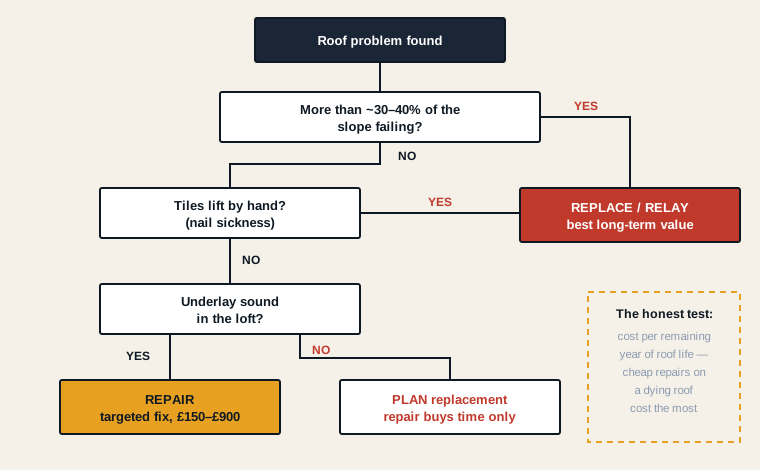
Concrete tile lasts ~40–60 years, clay ~60–100, slate ~80–150. But fixings fail first — so a 55-year-old roof that looks fine can start slipping across a slope as the nails corrode. Age sets the expectation; it does not settle it.
If under a third of the covering has failed and the rest is sound, repair. Once roughly a third or more is slipped, cracked or spent — or the same slope keeps failing — tile-by-tile repair becomes money poured into a dying roof.
Divide the cost by the years it realistically buys. A £400 repair that buys 2 years is £200/year and the leaks continue; a £8,000 re-roof lasting 50 years is £160/year and ends them. When the repair maths turns worse than the replacement maths, it is time.
South and west faces weather fastest. Re-covering the spent slope now and the sound one later is often the right middle path — which is why we quote per slope, not all-or-nothing.
Much of this stock — the terraces off Grovehill Road and the older streets near the Minster — is on its second covering already. Original Welsh slate is often worth repairing and matching for decades more; a poor 20th-century concrete recover over old timber is usually the thing to replace.
Often still on their original clay or early concrete covering and now near end of life. These are the roofs where the 30% rule bites: once one slope goes, the other is rarely far behind, and a planned re-roof beats a run of repairs.
Grovehill, Molescroft and similar post-war estates are the prime nail-sickness age right now. The tiles are frequently sound but the clips are corroding — classic slope-by-slope replacement territory, and rarely a genuine repair job once it starts.
| Situation | Honest call |
|---|---|
| One or two slipped tiles, covering sound | Repair — replacement is oversell |
| Single failed flashing or valley | Repair |
| Same slope failing repeatedly | Re-cover that slope |
| Nail sickness across a slope | Replace that slope |
| A third or more of the roof spent | Full re-roof |
| Sagging deck or spreading structural movement | Replace — and investigate structure first |
We put the remaining-life estimate in writing either way, so a "repair for now" decision is an informed one.
| Option | Cost | Years bought | Cost/year |
|---|---|---|---|
| Patch a spent roof | £400 | ~2 | £200 |
| Re-cover one failed slope | £3,500 | ~30 | £117 |
| Full concrete re-roof | £8,000 | ~50 | £160 |
| Full clay re-roof | £12,000 | ~80 | £150 |
Read down the last column: the cheapest thing on the day (the £400 patch) is the most expensive per year and leaves you still leaking. That is the whole case for replacement when a roof is genuinely spent — and equally the case against it when a roof still has decades left.
One more factor the maths alone misses: disruption and certainty. A run of repairs on a spent roof means repeat scaffolds, repeat call-outs and the standing worry of the next leak through a winter; a single planned re-roof ends that for a generation and comes with a fresh written guarantee and manufacturer warranty. Conversely, if your roof genuinely has decades left, spending that money now is capital tied up in a problem you do not have. We set both out plainly so the decision is yours, made on real numbers rather than a sales pitch — and we are glad to give a second opinion on a quote you have had from someone else.
Figures are illustrative Beverley ranges; your survey gives the real numbers. Re-roofing may qualify for reduced-rate VAT — we confirm in writing.
Roof condition, not age alone, should drive the repair-or-replace decision; a stock-condition survey assesses remaining service life against the cost of continued repair.
Source: RICS and BRE guidance on building stock condition and roof service life
A repair is a short, low-mess visit; a re-roof means scaffold, a skip and a few noisy strip days — which is itself part of the decision, and we set out both honestly. You do not need to stay home for external work - we just need power and access agreed in advance.
Repairs run year-round; we programme larger re-roofs and conservation work for settled spells. Hull Valley humidity and North Sea easterlies drive persistent moss growth and hard freeze-thaw cycling on exposed verges.
"They talked me out of a full re-roof I’d been quoted elsewhere — repaired one slope and told me the rest had years left. Saved me thousands."
"Clear explanation of cost per year that finally made the decision obvious. Went with the re-roof and no regrets."
"Honest about what needed doing now versus later. That’s why I’d use them again."
A common rule of thumb: once roughly a third or more of the covering has failed — slipped, cracked or spent — repairing tile-by-tile usually costs more over a few years than one planned re-roof. Below that, targeted repair is normally the better spend. It is a guide, not a law; condition matters more than any single percentage.
Concrete interlocking tiles last around 40–60 years, clay plain tiles often 60–100, and natural slate 80–150 with sound fixings. The fixings usually fail before the tile: nail sickness — corroded nails letting go — is the classic reason a sound-looking older roof starts slipping across a slope.
A single repair is always cheaper on the day. The honest comparison is cost per remaining year: a £400 repair that buys two more years costs £200/year; a £8,000 re-roof that lasts 50 years costs £160/year and ends the leaks. When repairs stack up on a spent roof, replacement is usually the cheaper choice over time.
If your roof is under about 35 years old, the covering is sound, and the fault is isolated — a slipped ridge, one failed flashing, a local valley — a re-roof is oversell. A good roofer repairs it and tells you roughly how many years the roof has left so you can plan.
Often, yes. South and west-facing slopes weather faster, so one slope can be spent while another is sound. Re-covering the failed slope now and the other later spreads the cost — we quote slope by slope rather than assuming all-or-nothing.
It is the starting point. Beverley’s Victorian and Edwardian roofs are usually on their second covering already; 1930s semis are often original and near end of life; 1960s–70s estates like Grovehill are the prime nail-sickness age now. Age plus condition, not age alone, makes the call.
Yes — our reputation locally depends on it. We will tell you to repair when repair is right, and we put the remaining-life estimate in writing so there is no pressure to replace before you need to.
A free survey and a written remaining-life estimate — so you repair when repair is right, and replace only when it pays.
0148 290 8437Last updated: August 2026